

India 2026: Where Private Capital Meets Public Market
Published on January 8, 2025 • 15 min read
Executive Summary
The Indian economy has entered a defining decade. By 2026, the lines between private markets and public markets are not only blurring but are actively converging. Private capital, long considered the engine of startup growth and venture expansion, is now flowing with greater intent towards the public sphere, while the stock markets are simultaneously becoming more receptive to innovative and high-growth businesses that were once confined to venture and private equity portfolios.
This convergence is not just financial; it represents a fundamental reordering of India's capital ecosystem. It reflects a deeper maturity of the market, the confidence of domestic and foreign investors in India's regulatory environment, and the sheer scale of opportunity available across industries.
The Historical Divide Between Private and Public Capital
For decades, India's private and public capital systems operated in parallel. Venture capital and private equity firms focused on early to growth-stage companies, providing patient risk capital in exchange for equity. These companies remained private for longer periods, relying on funding rounds for expansion. Meanwhile, the public markets were dominated by established corporations, often conservative in their governance and earnings growth.
The regulatory burden and disclosure requirements made public listing an intimidating prospect for young firms. Thus, only companies that had matured to significant scale pursued Initial Public Offerings (IPOs).
The result was a stark divide: innovation thrived in private markets, while stability defined the public markets.
India's Inflection Point
Between 2020 and 2025, three developments accelerated the bridging of this gap:
- 1.The Rise of Domestic Capital: Indian venture funds, family offices, and corporate venture arms grew in scale, reducing dependence on foreign money. This localized pool of capital aligned better with India's regulatory climate and long-term growth story.
- 2.Public Market Appetite for Growth Stories: The listing of new-age companies across e-commerce, fintech, and SaaS drew unprecedented retail and institutional participation, signaling that investors were willing to back innovation on the stock exchange.
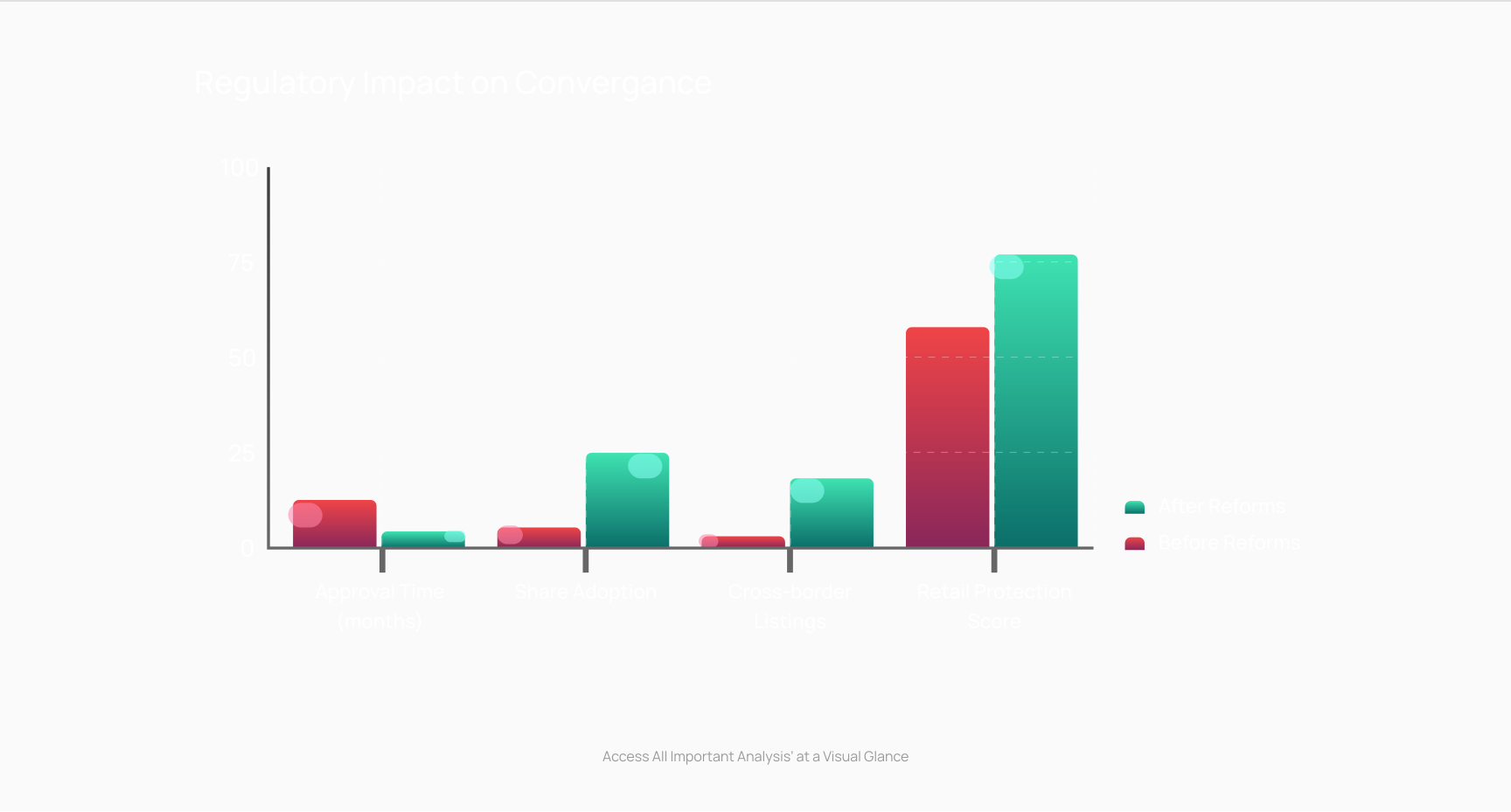
- 3.Policy and Regulatory Reforms: SEBI's initiatives around faster listing processes, relaxed disclosure requirements for startups, and frameworks for Special Purpose Acquisition Companies (SPACs) created smoother pathways between private capital and public markets.
By 2026, this shift has crystallized. Private capital and public markets are no longer separate universes but complementary phases of the same capital journey.
Private equity firms are increasingly designing exit strategies around public listings rather than secondary sales. Venture-backed startups now see IPOs not as distant goals but as realistic milestones achievable within shorter timelines. Conversely, public market investors—both domestic mutual funds and foreign portfolio investors—are embracing higher-risk, higher-reward growth companies with startup DNA.
This has created a dynamic loop: private capital incubates innovation, the public markets scale it, and the cycle replenishes with fresh capital.
Key Sectors Driving the Convergence
The interplay of private and public capital is most visible in specific industries that combine rapid innovation with scalable business models.
1. Financial Technology (Fintech)
India's fintech sector, having already attracted billions in private equity and venture capital, is now seeing multiple players list on the stock exchanges. Public market investors are recognizing fintech's role in driving financial inclusion.
2. Renewable Energy and Climate Tech
With India's ambitious 2030 green energy goals, this sector demands massive capital. Private equity initiates the high-risk infrastructure setup, while public markets (via InvITs and Green Bonds) provide long-term liquidity.
3. Healthcare and Life Sciences
Post-pandemic, healthcare innovation has surged. Diagnostics, specialized hospital chains, and health-tech platforms are maturing rapidly, moving from PE-backed consolidation to IPO-driven expansion.
4. SaaS and Digital Infrastructure
Global SaaS leaders building from India are finding ready acceptance. The predictable recurring revenue models of SaaS companies make them attractive to both growth-stage private investors and value-conscious public markets.
The Role of Regulatory Innovation
Regulation has been the silent architect of this convergence. By 2026, SEBI and RBI have enacted frameworks that both protect investor interests and encourage capital fluidity. Examples include:
- Faster IPO approvals: Streamlined processes allow companies to move from filing to listing within months.
- Dual-class share structures: Empowering founders to retain control while accessing public capital.
- Cross-border listing clarity: Rules enabling Indian companies to list overseas while remaining compliant domestically.
- Retail investor protections: Improved disclosure and risk frameworks to safeguard smaller investors as they enter high-growth IPOs.
These measures reduce friction between private incubation and public scaling.
Challenges in the New Ecosystem
While the convergence of private and public capital is a sign of maturity, it also brings risks.
- Valuation Gaps: Private markets often value companies on growth potential, while public markets demand profitability. Bridging these expectations remains a challenge.
- Governance Standards: Startups transitioning to public life must meet stricter corporate governance norms. Missteps can trigger reputational damage.
- Regulatory Arbitrage: As companies operate across both domains, inconsistencies in compliance could create loopholes or disputes.
- Investor Education: Retail investors entering innovative sectors may lack the expertise to assess long-term risks.
Opportunities for Stakeholders
- For Founders: Faster access to liquidity without surrendering control.
- For Investors: Broader exit options and diversification across capital structures.
- For Regulators: An opportunity to position India as a global capital hub with innovative yet stable frameworks.
- For Retail Investors: Access to high-growth stories previously reserved for private equity.
The Global Context
India's convergence is not isolated. In the United States, crossover funds like Tiger Global and Coatue pioneered this trend, investing in companies pre-IPO and post-IPO. In China, regulatory restrictions created waves of delistings and relistings, often driving firms abroad. India's uniqueness lies in its balanced approach: maintaining regulatory discipline while embracing innovation. This positions India as a potential capital hub for the Global South by 2030.
The Road to 2030
By 2026, the trajectory is clear: private and public capital are no longer rivals but collaborators. Looking towards 2030, we can expect:
- Deeper domestic capital pools through pension funds and sovereign wealth participation.
- Integration of ESG mandates across both private and public investments.
- Global Indian champions emerging from sectors like renewable energy, AI-driven platforms, and health-tech.
- Hybrid listing strategies where companies float partial IPOs while raising parallel private rounds.
Conclusion
India in 2026 is not merely a destination for capital; it is an ecosystem where private innovation and public scale reinforce each other. Private equity no longer ends with a sale to another fund, and IPOs are no longer the preserve of traditional giants. Instead, the two worlds are converging into a single, dynamic cycle of capital creation, deployment, and renewal. For founders, investors, and regulators alike, the challenge is to manage this convergence with wisdom, foresight, and balance. If done right, India will not just bridge the private and public markets but will emerge as a global leader in integrated capital systems by the end of the decade.